Actuator Solutions for Demanding Process Requirements
Actuators are central components of every valve. They safely move the ball valve into the desired position – manually, automatically, or via remote control.
Selecting the right actuator is crucial for:
Operational safety (Fail-Safe, ESD)
Service life of the valve and sealing system
Process reliability and smooth switching movement
Energy efficiency and maintenance requirements
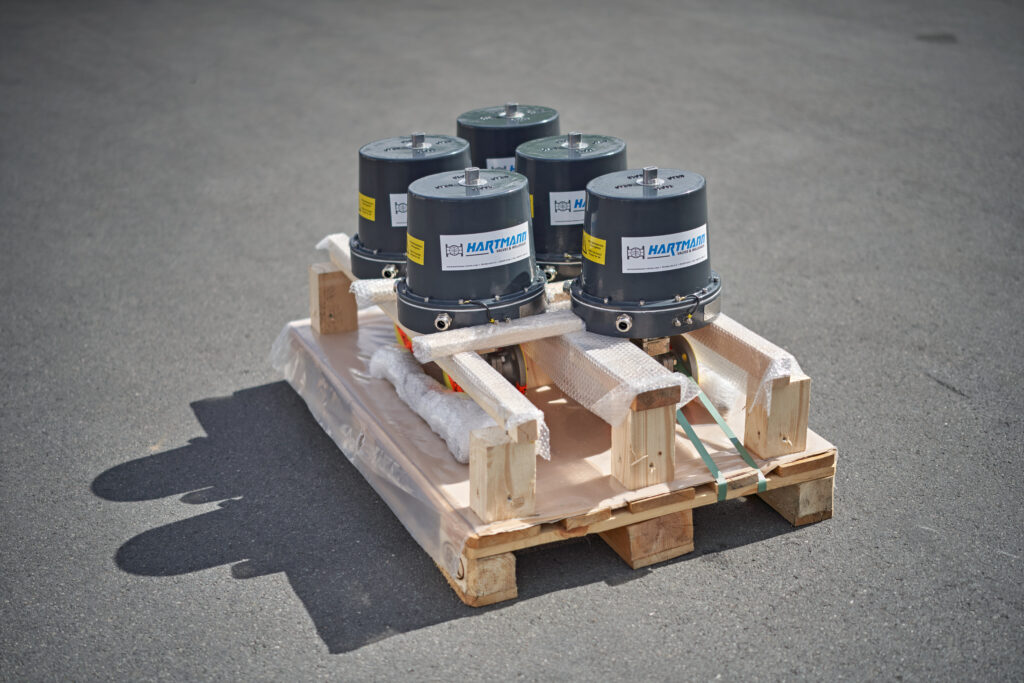
At Hartmann Valves, all actuators are individually designed for the respective application. Torque curves, safety requirements, environmental conditions, and switching cycles are all factored into the design.
The actuator is selected according to the specification, mounted on the valve, and tested together with it – ensuring an optimally coordinated, ready-to-operate unit.
Pneumatic actuators are available in single-acting and double-acting versions. They enable short switching times and cover a wide torque range.
Fail-safe functions can be implemented via spring packs or pressure accumulators as fail-open or fail-close versions. To improve movement quality, pneumatic actuators can be equipped with hydraulic dampers.
Features
Short switching times
Single-acting or double-acting version
Fail-open or fail-close possible
Optional hydraulic damping
Electric Actuators
Electric actuators enable precise positioning and smooth operation. They are suitable for on/off applications as well as control tasks and can be integrated into existing automation systems without an additional compressed air or hydraulic supply.
Fail-safe functions can optionally be implemented via battery or spring systems.
Features
Precise positioning
Smooth operation
Easy integration into automation systems
Optional fail-safe version
Hydraulic Actuators
Hydraulic actuators are used for applications with high torques. They enable short switching times and are also available for demanding operating conditions, such as offshore or subsea applications.
Fail-safe functions can be implemented via spring or pressure accumulator systems.
Features
High torques
Short switching times
Offshore and subsea applications
Fail-safe via spring or pressure accumulator
Electro-hydraulic Actuators
Electro-hydraulic actuators combine electric control with the power density of hydraulic systems. They are suitable for autonomous applications where no central compressed air or hydraulic supply is available.
The combination of compact design and high switching force enables precise and reproducible actuation.